Sand Casting Guide | Process, Types, Materials & Applications
Sand casting, one method in our aluminum casting guide, pours molten metal into an expendable sand mold formed around a pattern. This versatile manufacturing process accounts for a significant share of global casting tonnage and is ideal for low-to-medium production runs, large components, and complex internal features created using cores.
The Sand Casting Process Step by Step
Sand casting follows a systematic six-step process that transforms digital designs into finished metal components:
1. Pattern Making
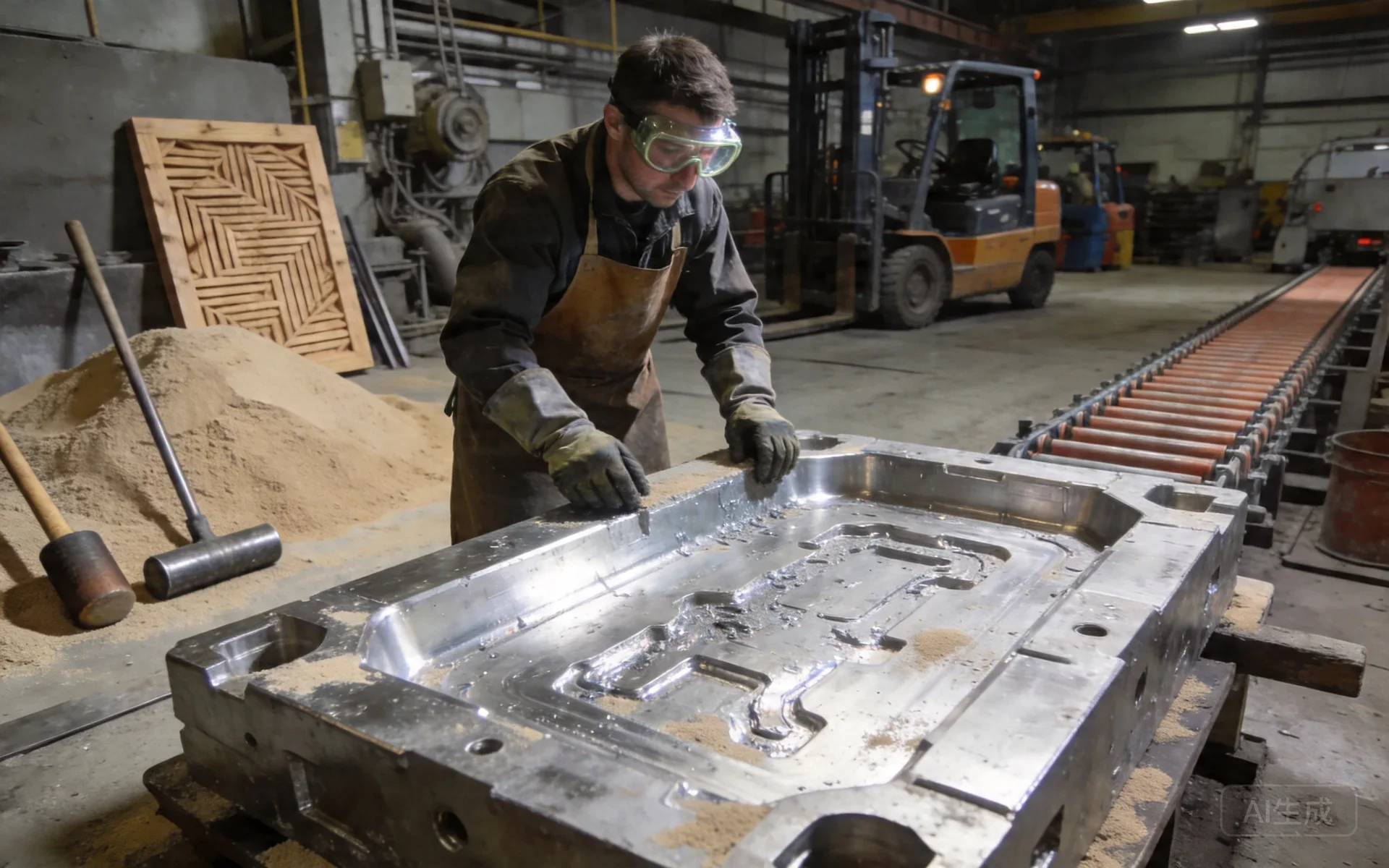
Wood, plastic, or metal patterns replicate part geometry with draft angles for mold release. Core boxes create internal passages. Modern patterns are CAD-driven with simulation software optimization.
2. Mold Preparation
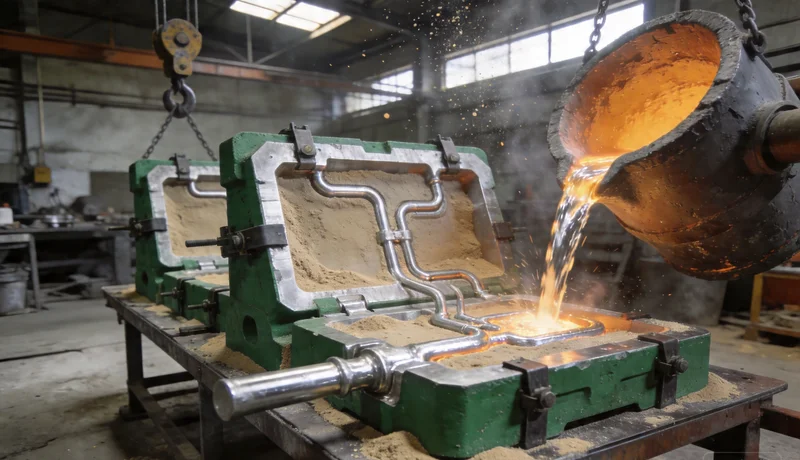
Silica sand mixed with binder is packed around the pattern, creating cope (top) and drag (bottom) halves. Gating systems and risers ensure proper filling and directional solidification.
3. Melting and Pouring
Induction furnaces heat aluminum to ~700°C. Gravity or low-pressure pouring minimizes turbulence to avoid gas entrapment and oxide formation in the casting.
4. Cooling and Solidification
Natural or controlled cooling allows metal to solidify. Riser design compensates for 1-2% shrinkage. Large castings may require hours to reach handling temperature.
5. Shakeout
Vibratory tables separate finished castings from sand molds. The sand is cleaned, screened, and recycled for future use, making the process environmentally sustainable.
6. Finishing Operations
Fettling removes risers and gates. Heat treatment (T6: solution at 540°C plus aging) optimizes mechanical properties. Final machining and surface finishing complete the process.
Types of Sand Casting
Green Sand Casting
Uses clay and moisture as binders (Ra 6-12 µm). Most common method for automotive housings and high-volume production. Low cost and environmentally friendly with excellent sand recycle rates.
No-Bake Furan Casting
Chemical resin binders cure at room temperature (Ra 4-8 µm). Ideal for complex prototypes and intricate cores. Higher dimensional accuracy but increased material costs.
Shell Mold Casting
Resin-coated sand forms thin shells (Ra 3-6 µm). Best surface finish and dimensional accuracy for small, precision components. Higher cost but superior quality.
| Type | Binder System | Surface Finish (Ra µm) | Typical Applications | Cost Level | Volume Suitability |
|---|---|---|---|---|---|
| Green Sand | Clay/moisture | 6-12 | Automotive housings | Low | High |
| Dry Sand | Baked clay | 5-10 | Large iron castings | Medium | Medium |
| No-Bake Furan | Chemical resin | 4-8 | Complex prototypes | Medium | Low-Medium |
| Shell Mold | Resin shell | 3-6 | Precision small parts | High | Low-Medium |
Selection Guide: Green sand leads aluminum casting globally due to cost-effectiveness and environmental benefits. No-bake systems excel for intricate cores and complex geometries requiring precise dimensional control.
Sand Casting vs Die Casting Decision Framework
Choosing between sand casting and die casting depends on production volume, part size, tolerances, and budget constraints. Here's a comprehensive comparison:
| Factor | Sand Casting | Die Casting |
|---|---|---|
| Tooling Cost | $1K-$10K | $50K-$500K |
| Part Size Range | Up to meters, unlimited | <50 kg typical |
| Production Volume | Low-medium (1-10K) | High (>10K) |
| Tolerances (ISO) | CT8-CT12 (±0.5-2mm) | CT4-CT7 (±0.1-0.5mm) |
| Surface Finish (Ra) | 6-12 µm as-cast | 1-3 µm as-cast |
| Geometric Complexity | High (cores for internals) | Moderate (limited undercuts) |
| Lead Time | 2-6 weeks | 8-16 weeks (tooling) |
| Wall Thickness | 3-50+ mm | 0.8-6 mm |
Choose Sand Casting When:
- Production volumes <5,000 pieces
- Parts weigh >20 kg
- Complex internal cores needed
- Large size components required
- Quick turnaround is critical
- Low initial investment needed
Switch to Die Casting For:
- High volumes (>10,000+ pieces)
- Thin wall requirements (<3mm)
- Tight tolerances (±0.1mm)
- Superior surface finish needed
- Maximum production efficiency
- Long-term production contracts
Decision Rule: Sand casting is optimal when volumes are below 5K pieces, parts exceed 20 kg, or complex cores are required. Die casting becomes economical for thin walls and high-volume production exceeding hundreds of thousands of pieces.
Materials for Sand Casting
Sand casting accommodates virtually all metals and alloys. Each material offers distinct properties for specific applications:
A356-T6 Aluminum
Ultimate tensile strength 280 MPa, yield strength 200 MPa, elongation 5-10%. The workhorse alloy combining excellent castability, weldability, and heat treatment response. Ideal for structural components.
A319 Aluminum
UTS 240 MPa, YS 170 MPa, elongation 3-5%. Automotive standard with good machinability and thermal conductivity. Common for engine blocks, transmission housings, and heat exchangers.
Gray Iron
UTS 200-400 MPa, excellent vibration damping. Traditional material for machine bases, engine blocks, and heavy industrial equipment requiring dimensional stability.
Ductile Iron
UTS 400-800 MPa, YS 300-500 MPa, elongation 10-18%. Superior toughness and impact resistance for gears, crankshafts, and high-stress structural components.
| Alloy | UTS (MPa) | YS (MPa) | Elongation (%) | Key Characteristics |
|---|---|---|---|---|
| A356-T6 | 280 | 200 | 5-10 | High strength, weldable — the workhorse |
| A319 | 240 | 170 | 3-5 | Automotive standard, good machinability |
| A413 | 220 | 140 | 3-8 | Excellent fluidity, thin sections |
| Gray Iron | 200-400 | 140-300 | 1-2 | Vibration damping, thermal stability |
| Ductile Iron | 400-800 | 300-500 | 10-18 | Toughness, impact resistance |
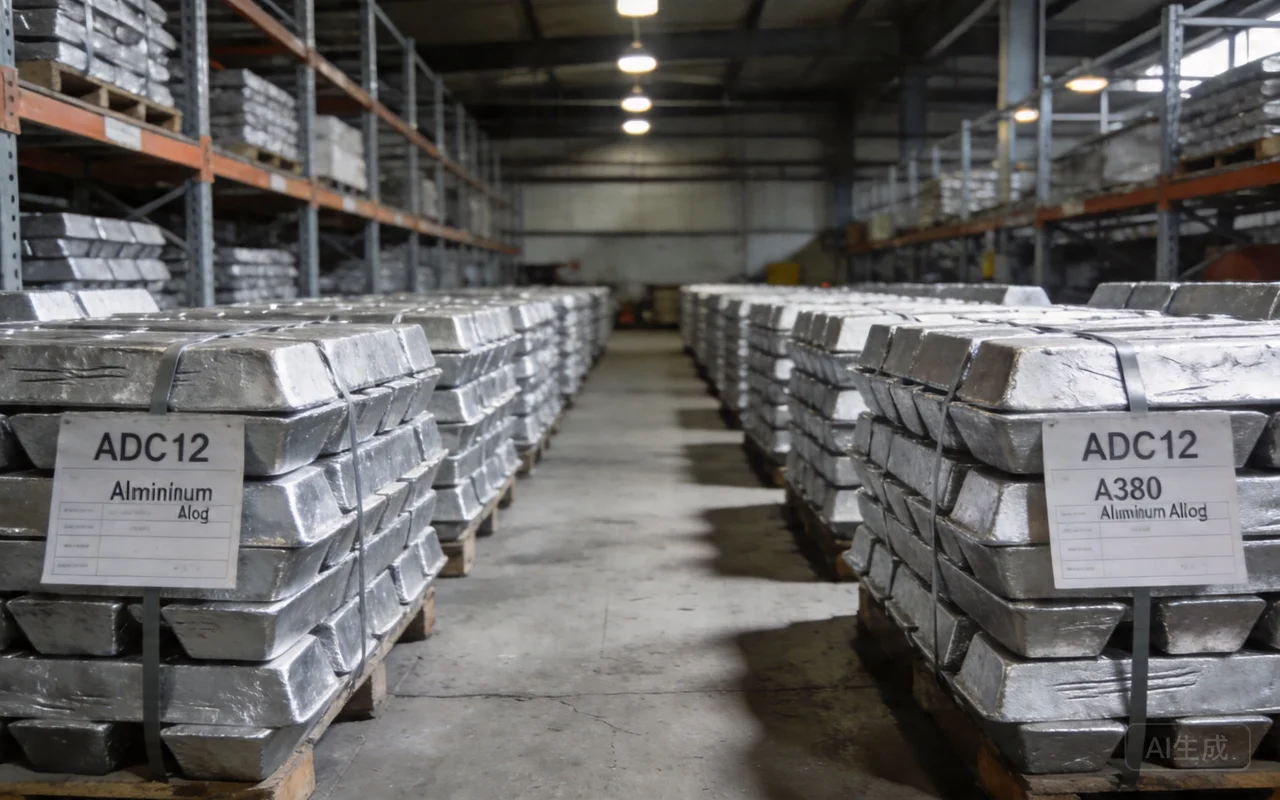
Material Selection: A356 (AlSi7Mg) remains the workhorse aluminum alloy, offering the ideal balance of castability, mechanical properties, and heat treatment response for most sand casting applications.
Tolerances and Surface Finish
ISO 8062 Tolerance Grades
CT8-CT12 grades provide ±0.5-2 mm for 100-500 mm dimensions. Casting shrinkage of 1-2% must be compensated in pattern design. Uniform wall sections minimize distortion.
Surface Quality
As-cast surfaces achieve Ra 6-12 µm depending on sand type and finishing. Post-machining operations can reduce surface roughness to Ra 1.6-3.2 µm for critical surfaces.
Design Considerations
Draft angles (1-3°), uniform wall thickness, and proper fillet radii optimize casting quality. Avoid sharp corners and sudden section changes to prevent stress concentrations and cracking.
| Dimension Range (mm) | ISO 8062 Grade | Tolerance (±mm) | Typical Application |
|---|---|---|---|
| 10-16 | CT8 | ±0.5 | Small precision components |
| 50-80 | CT9 | ±0.8 | General mechanical parts |
| 100-160 | CT10 | ±1.2 | Automotive housings |
| 250-400 | CT11 | ±1.8 | Large structural components |
| 400-630 | CT12 | ±2.5 | Heavy machinery bases |
Applications of Sand Casting
Automotive Industry
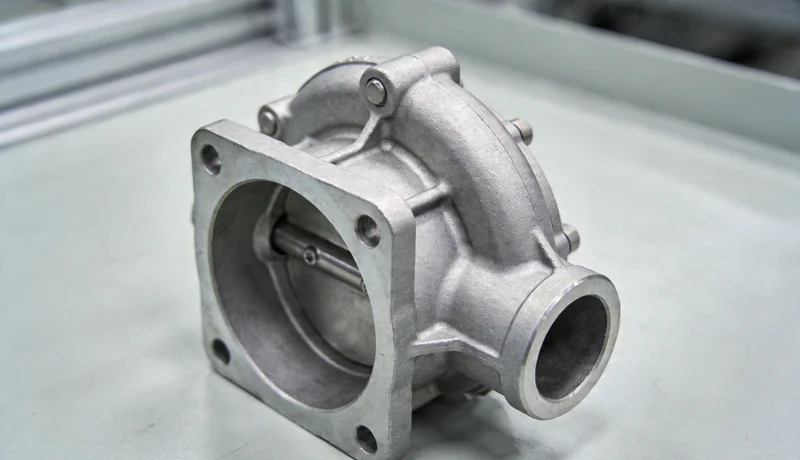
Cylinder heads, intake manifolds, transmission housings, and engine blocks using A356-T6. Sand casting provides the complex internal cooling passages and ports required for modern engines.
Industrial Equipment
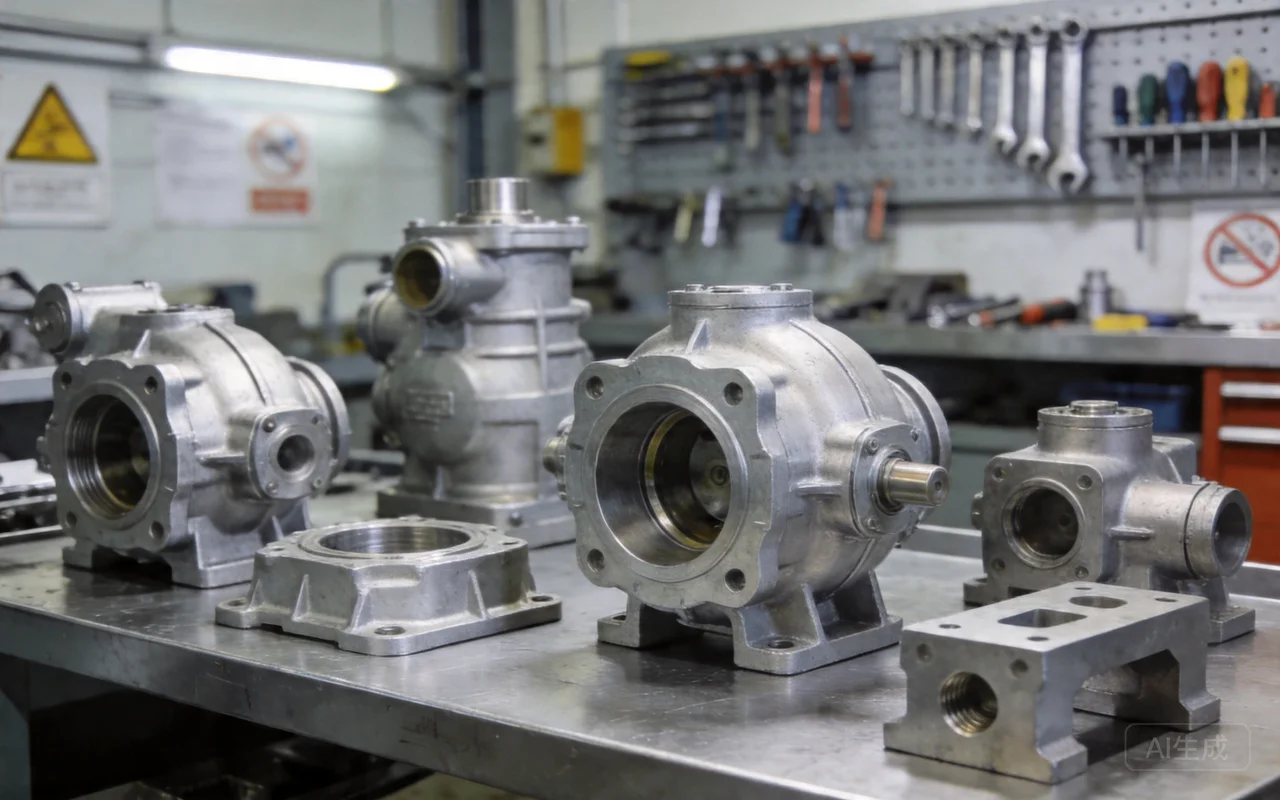
Pump bodies, valve housings, compressor components, and machinery bases typically use ductile iron for strength and vibration damping in heavy-duty applications.
Aerospace Components
Low-volume structural brackets, landing gear components, and engine mounts. Sand casting accommodates large, complex geometries difficult to machine from solid stock.
Marine Applications
Propeller hubs, rudder brackets, and marine hardware in bronze or aluminum. Corrosion resistance and complex geometries make sand casting ideal for marine environments.
Architecture & Art
Custom ornamental castings, architectural hardware, and sculptural elements. Sand casting offers unlimited size and design flexibility for unique artistic applications.
Energy Sector
Wind turbine hubs, hydroelectric components, and power generation equipment. Large size capabilities and material variety suit diverse energy applications.
Cost and Lead Time Analysis
Sand casting offers significant cost advantages for low-to-medium volume production due to lower tooling investment and faster setup times.
Tooling Costs
Pattern costs range from $1K-$10K depending on complexity and material. Wood patterns for prototypes, aluminum for production runs. Core boxes add $500-$2K for internal features.
Per-Part Economics
$5-20 at 1,000 units, $0.50-2 at 10,000 units. Material, size, and complexity drive costs. Large parts show 20-50% savings versus alternatives like welded fabrications.
Lead Time Breakdown
Total lead time: 2-6 weeks (1-2 weeks pattern making, 1-3 weeks production). Rush orders possible with existing patterns. Faster than die casting for initial parts.
Break-Even Analysis
Sand casting remains economical up to 5,000-10,000 pieces depending on part complexity. Beyond this volume, die casting or permanent mold becomes cost-effective.
| Cost Component | Percentage of Total | Typical Range | Cost Drivers |
|---|---|---|---|
| Material (aluminum) | 40-60% | $2-4/kg | Market price, yield, recycling |
| Labor & Processing | 25-35% | $0.50-2/kg | Complexity, batch size, automation |
| Tooling Amortization | 5-15% | $0.10-2/piece | Volume, pattern complexity |
| Finishing Operations | 10-20% | $0.25-1/kg | Machining, surface treatment |
Frequently Asked Questions
- What is the typical tolerance for sand casting?
- Sand casting typically achieves tolerances of ±0.5-2 mm for 100-500 mm dimensions according to ISO 8062 CT8-CT12 grades. Tighter tolerances may require post-machining operations on critical surfaces.
- How does sand casting compare to die casting in cost?
- Sand casting has much lower tooling costs ($1K-$10K vs $50K-$500K for die casting) but higher per-part costs at volume. Sand casting is economical for 1-10K parts, while die casting becomes cost-effective above 10K pieces.
- What materials can be used in sand casting?
- Sand casting supports nearly all metals including aluminum alloys (A356-T6, A319), gray and ductile iron, steel, bronze, and magnesium. A356 aluminum is most common for its excellent castability and heat treatment response.
- What size parts can be sand cast?
- Sand casting can produce parts from a few grams to several tons. There's virtually no upper size limit, making it ideal for large industrial components, architectural pieces, and heavy machinery parts.
- How long does the sand casting process take?
- Lead times range from 2-6 weeks total: 1-2 weeks for pattern making and 1-3 weeks for production. Rush orders are possible with existing patterns. Much faster than die casting for initial parts.
- What surface finish can sand casting achieve?
- As-cast surface finish ranges from Ra 6-12 µm depending on sand type. Green sand produces rougher surfaces, while shell molding achieves Ra 3-6 µm. Post-machining can reduce roughness to Ra 1.6 µm.
- Can sand casting produce hollow or internal features?
- Yes, sand cores create complex internal passages, cooling channels, and hollow sections that would be impossible to machine. This is a key advantage of sand casting over machining from solid stock.
- Is sand casting environmentally friendly?
- Sand casting is highly sustainable with 95%+ sand recycling rates. Aluminum has excellent recyclability, and the process generates minimal waste compared to subtractive manufacturing methods.