Aluminum Die Casting Guide: Process, Alloys, Applications & Cost Analysis
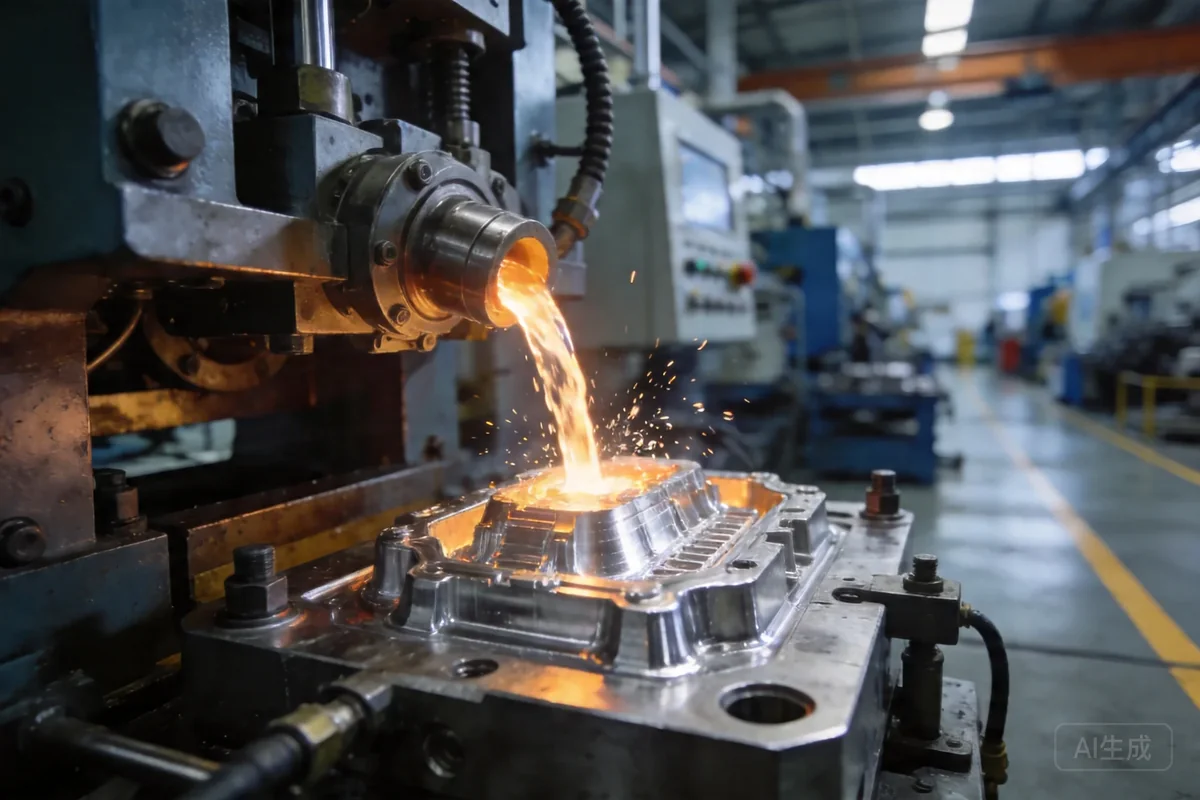
Aluminum die casting is a high‑precision metal forming process where molten aluminum is injected into a hardened steel mold under high pressure to produce near‑net‑shape components. See our aluminum casting guide for how die casting fits with sand and gravity methods; use our material comparison for ADC12 vs wrought alloys and CNC machining guide for post-cast finishing.
What is Aluminum Die Casting?
Basic Definition and Working Principle
Aluminum die casting forces molten aluminum, typically at temperatures above about 700 °C, into a steel mold (die) at high pressure using a specialized die casting machine. The die consists of at least two halves that form a precise cavity; after the aluminum fills the cavity and solidifies, the die opens and ejector pins push out the part. Because the cavity is machined in hardened steel, the process can be repeated tens of thousands of times with consistent geometry and minimal variation. This makes die casting ideal for producing near‑net‑shape parts that require little machining and can incorporate complex details such as ribs, bosses, and thin walls.
Key Advantages Over Other Casting Methods
Aluminum die casting offers very high dimensional accuracy and repeatability, often exceeding what sand and gravity casting can achieve. It provides excellent surface finish (Ra commonly around 1.6–3.2 µm) that often eliminates the need for heavy machining or polishing. Cycle times are short—often on the order of 30–120 seconds per shot—making it highly productive for large batch runs. Compared with other casting methods, die casting achieves thinner walls, tighter tolerances, and better integration of complex geometries, which reduces part count and assembly costs.
Typical Applications Overview
Die‑cast aluminum is used widely for automotive engine and transmission housings, brackets, covers, and increasingly large structural components in electric vehicles. Electronics and telecom products use die casting for heat sinks, enclosure housings, and connector bodies that need good thermal conductivity and shielding. Industrial equipment relies on die‑cast parts for pump housings, gearbox cases, and precision hardware, while emerging new energy applications include EV motor/inverter housings and charging infrastructure components.
Types of Aluminum Die Casting
High Pressure Die Casting (HPDC) HPDC injects molten aluminum into steel dies at pressures often ranging from roughly 700 to over 1,000 bar, filling the cavity in milliseconds. It is optimized for thin‑wall, complex parts and very high production volumes, offering the lowest per‑part cost once tooling is amortized. Typical parts range from small electronic housings and brackets to medium‑sized automotive components such as transmission cases and motor housings.
HPDC vs LPDC vs gravity die casting
| Attribute | HPDC | LPDC | Gravity die casting |
|---|---|---|---|
| Typical pressure range | ~700–1,200 bar metal injection pressure. | ~0.3–1 bar gas pressure above melt to fill mold. | Essentially 1 bar; gravity filling with occasional low assist. |
| Typical part size / volume | Small–medium parts, very high volumes (10k–1M+ parts/year). | Medium‑sized parts, medium volumes (wheels, structural castings). | Small–medium parts, low–medium volumes. |
| Wall thickness capability | Very thin walls (≈1.5–3 mm depending on size). | Moderate walls (typically >3–4 mm). | Moderate–thicker walls; not as thin as HPDC. |
| Surface finish | Excellent; Ra ≈ 1.6–3.2 µm. | Good; often slightly rougher than HPDC. | Good; better than sand, slightly below HPDC. |
| Dimensional tolerance | Tightest; often around ±0.10–0.25 mm on small features. | Moderate; tighter than sand, looser than HPDC. | Moderate; similar to LPDC. |
| Tooling cost | Highest (complex, high‑strength dies). | High but often below HPDC for similar size. | Medium; simpler tooling than HPDC/LPDC. |
Low Pressure Die Casting (LPDC)
LPDC uses a sealed furnace with a riser tube; low gas pressure (typically around 0.3–1 bar overpressure) pushes molten metal upward into a permanent mold. Filling is slower and more controlled than HPDC, leading to lower turbulence and improved feeding, which enhances mechanical properties and reduces porosity. LPDC is widely used for automotive wheels and structural components that require better fatigue properties and thicker sections than typical HPDC parts.
Gravity Die Casting (Permanent Mold)
Gravity die casting (permanent‑mold casting) pours molten aluminum into a reusable metal mold under gravity alone, sometimes with slight tilt or low‑pressure assistance. It offers better properties and surface finish than sand casting and is suitable for medium volumes and moderate wall thicknesses. Common parts include wheels, suspension arms, and medium‑sized housings where LPDC or HPDC may not be necessary or economical.
The High Pressure Die Casting Process Step by Step
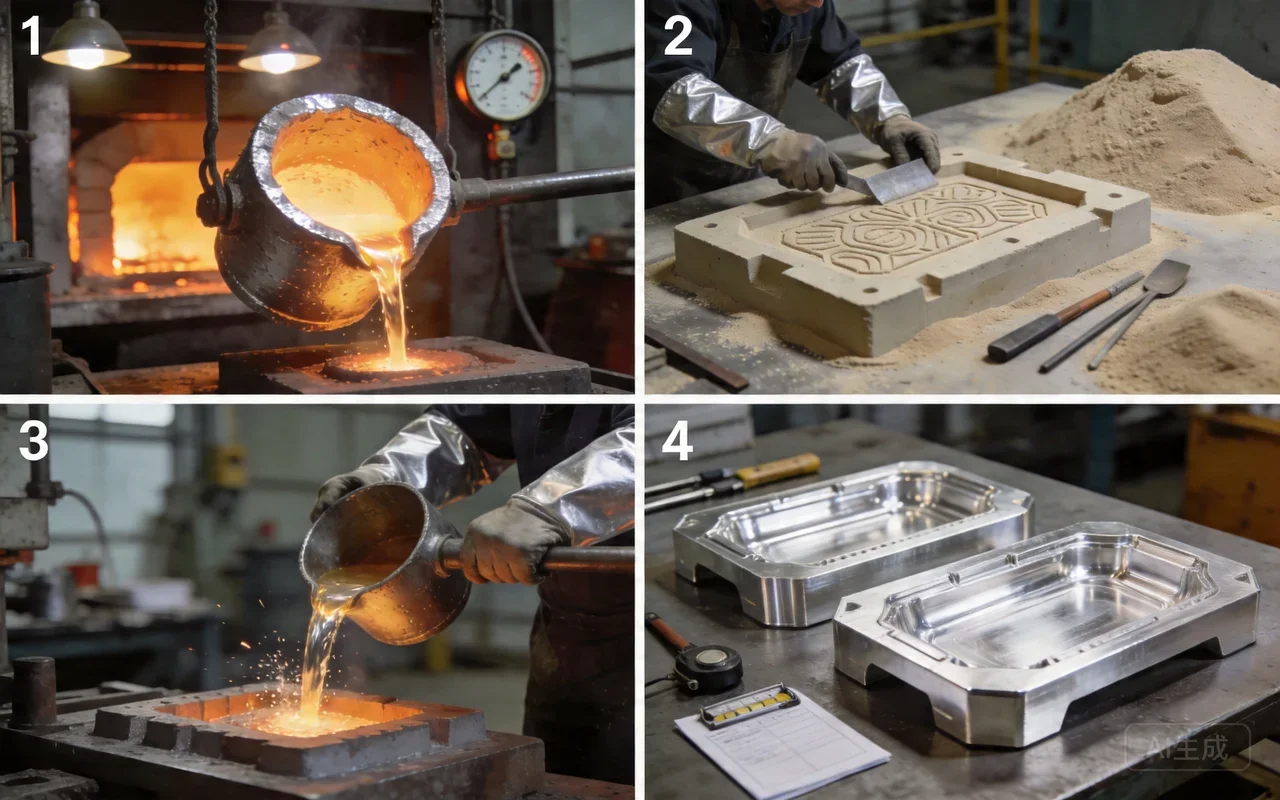
Mold Preparation and Lubrication The cycle begins with closing and clamping the die halves using a cold‑chamber or hot‑chamber machine, applying clamping forces sufficient to resist cavity pressure. Before each shot, the cavity surfaces and ejector pins are sprayed with die lubricant to aid ejection, control heat transfer, and reduce soldering or erosion of the die steel. NADCA guidelines specify lubrication frequency, spray patterns, and die temperature ranges to maintain process stability and surface quality.
Metal Melting and Holding
Aluminum ingots and returns are melted in a furnace and held in a separate holding furnace at controlled temperature, typically above 700 °C to ensure fluidity while limiting oxidation. Melt treatment steps such as degassing with inert gases and fluxing remove hydrogen and oxides to reduce porosity. The molten metal is transferred to the shot sleeve (cold‑chamber) or is already in the machine (hot‑chamber for other alloys), ready for injection.
Injection Stage — Fill, Intensification, and Solidification
In cold‑chamber HPDC, plunger speeds and shot profiles are carefully controlled; the metal is first moved slowly to the gate and then accelerated to high speed for cavity filling. Filling times are very short—often a few tens of milliseconds—to avoid premature solidification and ensure complete filling of thin sections. After the cavity is full, intensification pressure (hundreds of bar) is applied to compensate for shrinkage during solidification, improving density and surface quality. ASM and NADCA data emphasize optimizing gate velocity, shot profiles, and die venting to minimize air entrapment and porosity.
Cooling and Ejection
Cooling occurs while the die remains clamped, with internal cooling channels circulating water or oil to control die temperature and solidification rate. Cycle time for cooling depends on part size and wall thickness but commonly ranges around 30–120 seconds for many aluminum parts. Once the casting reaches sufficient rigidity, the die opens, and ejector pins push the casting and attached runners out of the cavity. Robots or operators remove the casting and send it to trimming stations, while the die closes for the next cycle.
Trimming and Secondary Operations
Trim dies or presses remove gates, runners, and flash, leaving the net casting body for further processing. Secondary operations include shot blasting, deburring, CNC machining, drilling and tapping holes, and applying surface treatments such as powder coating or anodizing. For pressure‑tight parts, leak testing and, if needed, impregnation (resin sealing) may be used to ensure sealing performance.
Cold Chamber vs Hot Chamber Machines
Aluminum die casting almost always uses cold‑chamber machines because aluminum’s higher melting temperature and chemical reactivity would damage immersed injection components in hot‑chamber systems. In cold‑chamber machines, metal is ladled into the shot sleeve each cycle, while in hot‑chamber machines (used for zinc or magnesium), the injection mechanism is submerged in molten metal, enabling faster cycles but limited to lower melting alloys. Machine selection influences achievable injection speeds, shot sizes, and the overall productivity envelope for aluminum die casting.
Aluminum Die Casting Alloys and Material Selection
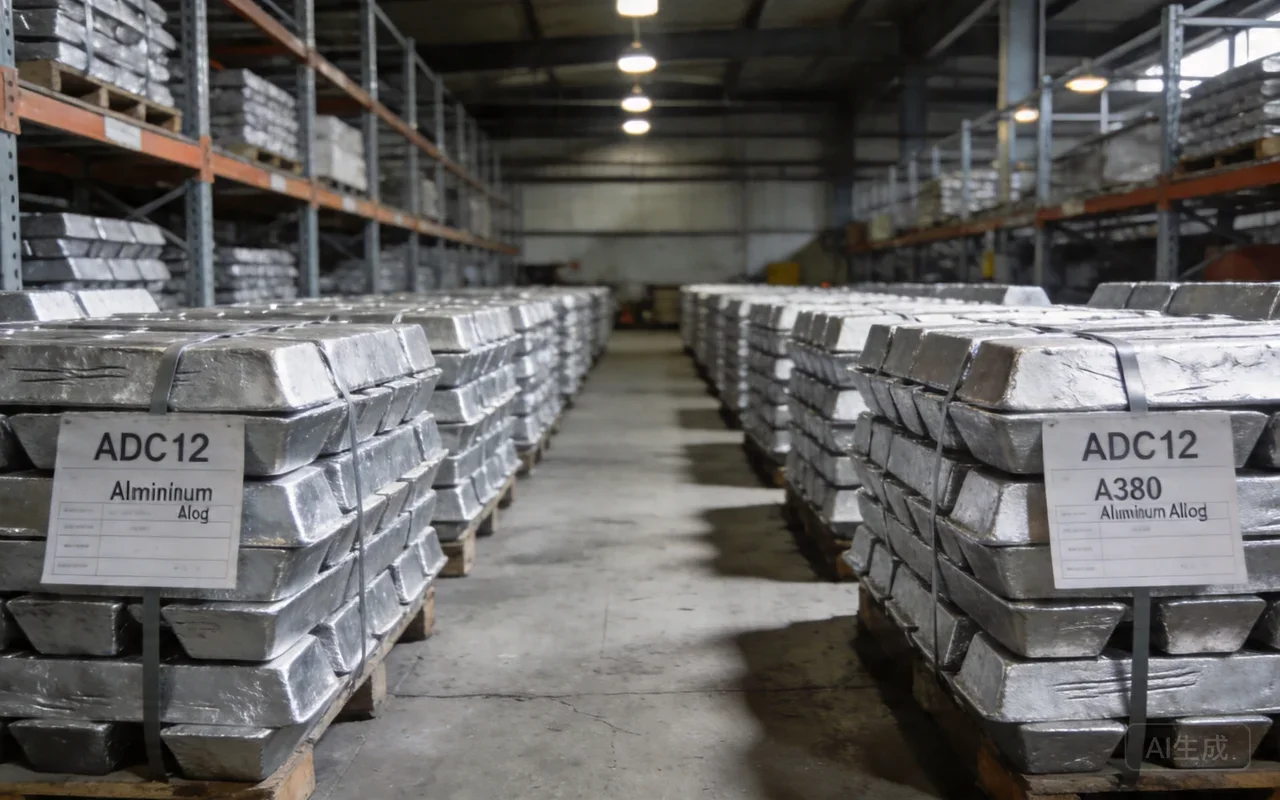
ADC12 — The Global Standard Die Casting Alloy ADC12 is a JIS aluminum‑silicon‑copper alloy widely used in Asia and globally for high‑pressure die casting, valued for its excellent fluidity and castability. Its composition typically includes around 9.6–12% Si and 1.5–3.5% Cu, which give good strength and pressure‑tightness in as‑cast condition. ADC12 is used for automotive and motorcycle components, electronic housings, and general mechanical parts that require thin walls and high productivity.
Alloy comparison
| Alloy | Key chemistry | Typical use | Strength (relative) | Ductility (relative) | Corrosion resistance | Fluidity & castability | Relative cost |
|---|---|---|---|---|---|---|---|
| ADC12 | ~10–12% Si, 1.5–3.5% Cu. | General‑purpose HPDC, automotive, electronics. | High as‑cast. | Moderate. | Moderate (Cu present). | Excellent fluidity. | Very cost‑effective. |
| A380 | ~7.5–9.5% Si, 3–4% Cu. | Most common North American alloy; engine & transmission parts. | High; ~300+ MPa UTS typical. | Moderate‑low. | Lower than low‑Cu alloys. | Very good castability. | Baseline/low cost. |
| A383 | Similar to A380, optimized for fluidity. | Complex, thin‑wall castings. | Moderate‑high. | Improved vs A380. | Moderate. | Excellent for thin walls. | Similar to A380/ADC12. |
| A413 | ~12% Si, low Cu. | Pressure‑tight & corrosion‑resistant parts. | Moderate. | Moderate. | Better than A380/ADC12. | Very good. | Slightly higher for specialty uses. |
| EN AC‑46000 | European Al‑Si‑Mg/Cu die casting grade (similar to A380 family). | EU automotive & industrial die castings. | High. | Moderate. | Moderate. | Good castability. | Comparable to A380. |
A380 — Most Common North American Alloy
A380 is one of the most widely used aluminum alloys for die casting in North America, offering a strong balance of castability, mechanical strength, and cost. It contains approximately 7.5–9.5% Si and 3–4% Cu, achieving tensile strengths around 300+ MPa in typical die‑cast conditions. Applications include engine covers, transmission housings, structural brackets, and a broad range of industrial components.
A383 — Improved Mechanical Properties
A383 (also referred to as 383) is a variant of A380 formulated to improve fluidity and reduce hot cracking, particularly for complex, thin‑wall parts. It typically provides better ductility and fill characteristics than A380, at the cost of slightly different strength and corrosion behavior. A383 is chosen for intricate housings and connectors where complete filling and reduced scrap are critical.
A413 — Superior Corrosion Resistance
A413 is a high‑silicon alloy (commonly around 12% Si) with lower copper, giving very good castability and improved corrosion resistance relative to more Cu‑rich die casting alloys. It is frequently used for intricate components, pump housings, and parts that require leak‑tightness and good pressure performance. A413’s combination of fluidity and resistance to leakage makes it attractive for fluid handling and hydraulic components.
Alloy Selection Decision Guide by Application
Automotive engine and transmission housings: A380 or ADC12 for castability and strength; A383 for especially complex housings.
Electronics housings and heat sinks: ADC12, A380, or A413 depending on corrosion and thermal requirements.
Fluid handling components: A413 for pressure‑tightness and corrosion resistance; sometimes A380/ADC12 if cost and mechanical strength dominate.
Thin‑wall, complex connectors: A383 or ADC12 to maximize fluidity and reduce misruns.
Applications of Aluminum Die Casting Across Industries
Automotive Components — Engine Blocks, Transmission Housings, Structural Parts
Die casting is heavily used for engine covers, transmission cases, oil pans, and numerous brackets because it supports complex shapes, integrated features, and thin walls for weight reduction. Alloys like A380, ADC12, and EN AC‑46000 are common due to their balance of strength, castability, and cost. Increasingly, large die‑cast structural components in EV platforms (e.g., motor housings, inverter housings) are replacing multi‑piece weldments.
Electronics Enclosures — Housings, Heat Sinks, Connectors
Electronics and telecom products use die‑cast aluminum for housings that require electromagnetic shielding, good thermal conductivity, and precise connector interfaces. Heat sinks, LED lighting housings, and communication base station enclosures are frequently made with A380, ADC12, or A413, depending on corrosion and thermal demands. Die casting allows thin fins, detailed mounting features, and integrated sealing flanges.
Industrial Equipment — Pump Housings, Gearboxes, Valve Bodies
Industrial pumps, compressors, and gearboxes use die‑cast housings for their combination of strength, weight savings, and machinability. A413 and A380/ADC12 are common choices; the former is often used when pressure‑tightness and corrosion resistance are critical. Die casting enables integrated mounting feet, bosses, and internal channels that reduce secondary fabrication steps.
New Energy Applications — EV Battery Housings, Charging Components, Solar Mounts
In the new energy sector, die‑cast aluminum is used for EV inverter and motor housings, battery tray components, on‑board charger housings, and DC fast charger enclosure parts. These components benefit from die casting’s ability to integrate cooling channels, mounting features, and thin‑wall designs for weight reduction. Solar mounting systems and inverter housings sometimes also use die castings for complex shapes and assembly integration.
Aluminum Die Casting Mold Design and Tooling
Mold Construction and Key Components
A die casting mold typically includes cavity and core blocks, runners and gates, ejector systems, slides and cores for undercuts, and cooling channels. Multi‑cavity dies are common to increase productivity, especially for smaller parts. Accurate mold construction is critical to maintain parting lines, match lines, and dimensional tolerances over the mold’s life.
Tool Steel Selection for Die Casting Molds
Hot‑work tool steels such as H13 and H11 are standard for aluminum die casting dies because they withstand thermal cycling and erosion. These steels offer good toughness and resistance to heat checking, especially when combined with surface treatments such as nitriding or PVD coatings. Proper steel selection, heat treatment, and surface engineering significantly influence die life and maintenance requirements.
Cooling Channel Design and Thermal Management
Effective cooling channel layout ensures uniform die temperatures, controlling solidification and reducing hot spots that cause soldering and premature die failure. Conformal cooling and optimized water/oil circuits help stabilize cycle times and improve dimensional consistency. NADCA guidelines emphasize thermal balance and temperature window control for consistent quality.
Expected Mold Life and Maintenance
Industry sources indicate typical aluminum die casting molds can last about 80,000–150,000 shots under good design and operating conditions. Tool life depends on alloy temperature, part geometry, die steel, and maintenance practices; some molds may exceed this range while others wear out earlier under harsh conditions. Preventive maintenance—polishing, repairing cracks, and replacing wear components—extends service life and maintains part quality.
Mold Cost Estimation Guide
Simple single‑cavity small molds: typically in the low tens of thousands USD.
Medium‑complexity multi‑cavity dies with slides: often in the mid‑five to low‑six‑figure USD range.
Large automotive structural dies: can reach several hundred thousand USD or more, especially for multi‑cavity or family tools.
Quality, Tolerances and Surface Finish in Die Casting
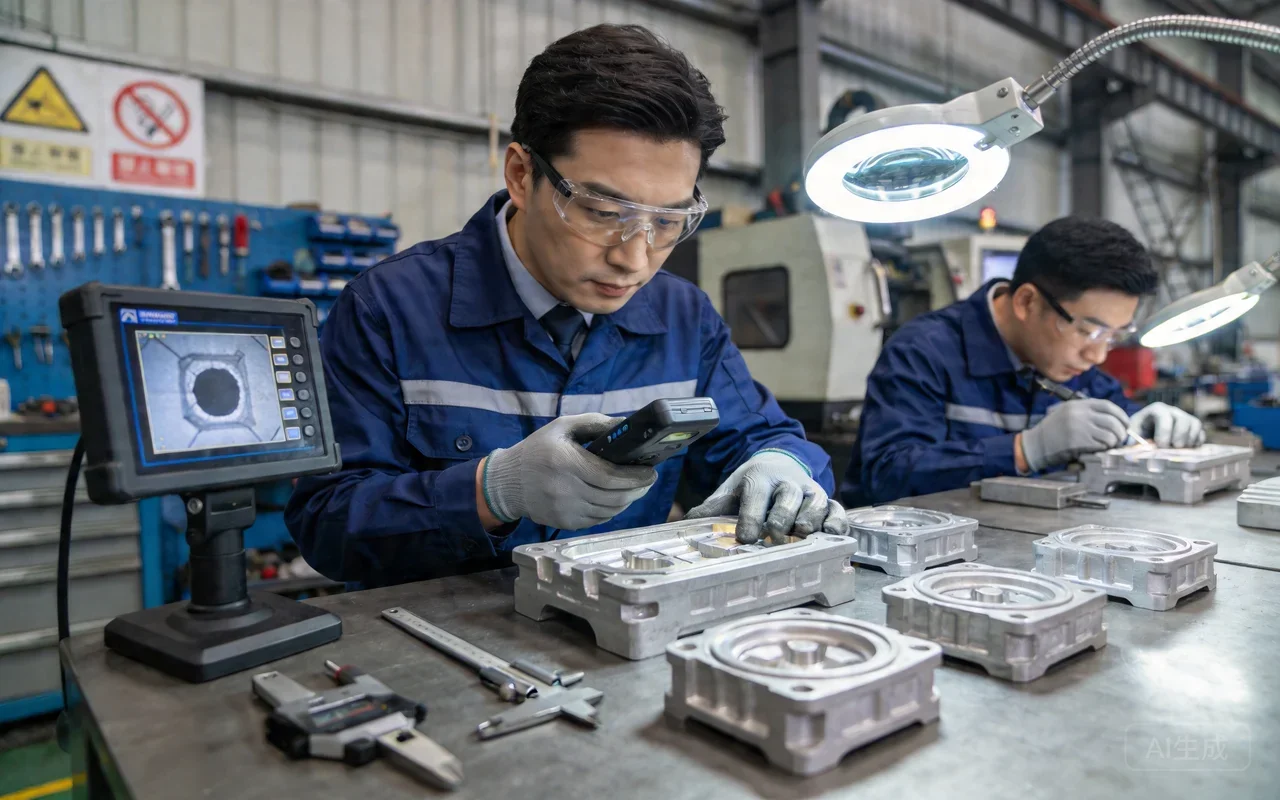
Dimensional Tolerances by Die Casting Type Aluminum die casting can achieve tight linear tolerances, commonly around ±0.10–0.25 mm on small dimensions, with looser values for longer spans. NADCA tolerance guidelines and supplier tables refine these ranges by feature size and casting configuration. LPDC and gravity die cast parts generally have slightly looser tolerances than HPDC but still outperform sand castings.
Surface Finish Capabilities
HPDC provides a fine surface finish, often with Ra values around 1.6–3.2 µm, suitable for many cosmetic and functional surfaces without heavy machining. LPDC and gravity die casting produce surfaces somewhat rougher but still better than typical sand molds. Proper die polishing, lubricant selection, and process control are important to maintain consistent appearance and minimize cosmetic defects.
Inspection and Quality Assurance Methods
Quality assurance typically includes dimensional inspection using calipers, gauges, and CMMs to verify critical features. For structural and pressure‑containing parts, X‑ray or CT scanning detects internal porosity and cracks, while pressure/leak testing validates sealing performance. Mechanical tests (tensile, hardness) and statistical process control are used to monitor alloy and process stability.
Aluminum Die Casting Cost Factors and Pricing Guide
Tooling Costs by Part Complexity
Simple, small parts: lower tooling cost, often at the lower end of die price ranges (tens of thousands USD).
Medium‑complex parts with slides/cores: mid‑range tooling costs, often mid‑five figures.
Large structural or multi‑cavity dies: highest investment, potentially several hundred thousand USD.
Per-Part Cost by Production Volume
Low volume (<1,000 pcs/year): Per‑part cost is relatively high due to tooling amortization; other processes may be cheaper overall.
Medium volume (~1,000–20,000 pcs/year): Die casting becomes more competitive, especially for smaller parts.
High volume (>20,000–50,000 pcs/year): Die casting often offers the lowest per‑part cost among casting and machining options because of high productivity.
Cost Comparison: Die Casting vs Sand Casting vs CNC Machining
Versus sand casting: Higher tooling cost but much lower per‑piece cost and better quality at high volumes; sand casting is more economical for large, low‑volume parts.
Versus CNC machining: Die casting drastically reduces material waste and machining time for complex parts at volume, while CNC machining is better for prototypes or very low volumes.
Secondary Operations Cost Adders
Secondary operations such as CNC machining, drilling/tapping, shot blasting, and coating add to part cost, often substantially for tight‑tolerance or decorative components. Leak testing, impregnation, and multi‑step finishing (anodizing + painting) can significantly increase total piece price for critical parts. Design choices that reduce machining stock and simplify finishing can yield notable cost savings.
Aluminum Die Casting vs Sand Casting vs Investment Casting
When Die Casting is the Best Choice Die casting is ideal when you need high volumes of small‑to‑medium aluminum parts with tight tolerances, thin walls, and good surface finish. It is best when you can justify tool investment with production quantities and want to integrate many features in a single part.
Summary comparison
| Factor | Die casting (HPDC) | Sand casting | Investment casting |
|---|---|---|---|
| Volume range | Best high volume. | Best low–medium volume, large parts. | Low–medium volumes, complex parts. |
| Surface finish | Very good (low Ra). | Rough. | Very good. |
| Dimensional accuracy | Tightest among three. | Loosest. | Good–tight. |
| Tooling cost | High. | Low. | Medium. |
| Lead time | Longer to tool, fast once running. | Shorter for tooling. | Moderate–long. |
For secondary operations and finishes after casting, see our CNC machining guide and Surface Finishing and CNC Machining.
When Sand Casting is Better
Sand casting is better for very large parts, low volumes, or when tooling budget is limited and rougher surfaces plus more machining are acceptable. It accommodates thicker sections and designs that would be impractical or too costly to tool for HPDC.
When Investment Casting Makes Sense
Investment casting (lost‑wax) offers excellent surface finish and good dimensional accuracy for complex shapes at lower volumes than die casting, but with higher per‑part costs and longer lead times. It is useful when design complexity is high, material options vary, or very fine detail is needed without extremely high volumes.
Design for Die Casting Principles
Wall Thickness Design Rules
Uniform wall thickness is central to good die casting design; typical walls are in the 1.5–3 mm range for many aluminum die cast parts, thicker for large parts. Sudden thickness transitions should be avoided; gradual tapers or fillets reduce hot spots and shrinkage defects.
Draft Angles and Parting Line Design
Draft angles help parts release from the die; values around 1–3 degrees on interior and exterior walls are commonly recommended. Parting lines should be located to simplify tooling and minimize side actions, which lower cost and improve die life. NADCA guidelines recommend aligning major features with the primary opening direction whenever possible.
Rib Design, Boss Design and Coring
Ribs should be thinner than the adjoining walls (often 50–70% wall thickness) to prevent sink marks and shrinkage while increasing stiffness. Bosses for fasteners should have filleted bases and be cored out where possible to maintain uniform section thickness. Coring is used to create cavities and reduce mass; properly designed cores reduce cycle time and improve solidification.
Gate and Overflow Design
Gate locations and sizes must ensure smooth, balanced filling and minimize air entrapment; NADCA provides guidance on gate velocity and thickness. Overflows and vents collect cold metal and trapped gases, improving internal quality and reducing porosity. Proper overflow design also helps stabilize thermal conditions at the die surface.
Frequently Asked Questions
- What is the difference between high pressure and low pressure die casting?
- High pressure die casting injects molten aluminum into the die at very high pressures and speeds, ideal for thin‑wall, high‑volume parts. Low pressure die casting fills the mold more slowly using low gas pressure from below, improving feeding and mechanical properties but with longer cycles and thicker walls.
- What is the most commonly used aluminum alloy for die casting?
- A380 is widely cited as the most commonly used alloy in North America, while ADC12 is a global standard in Asia; both offer excellent castability and good mechanical properties.
- How long does a die casting mold last?
- Typical aluminum die casting molds last roughly 80,000–150,000 shots under good design and process conditions, though actual life can be lower or higher depending on usage.
- What tolerances can I expect from aluminum die casting?
- Many suppliers quote linear tolerances around ±0.10–0.25 mm for small dimensions, with larger features having proportionally larger tolerances per NADCA guidelines. Critical features are often machined to achieve tighter tolerances where needed.
- Is aluminum die casting suitable for low volume production?
- It is usually not cost‑effective for very low volumes because of high tooling costs; sand casting, investment casting, or CNC machining are often better options below roughly 1,000–2,000 parts.
- How much does it cost to make a die casting mold?
- Small, simple dies can start in the low tens of thousands USD, while complex multi‑cavity or large structural dies can reach into the hundreds of thousands USD.
- What is the minimum wall thickness for aluminum die casting?
- Minimum walls around 1.5–2.0 mm are common for many HPDC parts, with slightly thicker walls required for larger or less optimized designs.
- How does die casting compare to sand casting in terms of cost and quality?
- Die casting has higher upfront tooling cost but lower per‑part cost, better tolerances, and superior surface finish at high volumes. Sand casting has lower tooling cost and suits large or low‑volume parts but yields rougher surfaces and looser tolerances, requiring more machining.