Choosing the right aluminum material for casting or machining is critical for mechanical performance, total cost, and manufacturability. Alloy chemistry directly controls yield strength, elongation, corrosion resistance, and how a part responds to heat treatment or secondary operations. Selecting an over-spec alloy such as 7075 when 6061 suffices can increase raw material cost by 40–60% with no functional benefit.
Wrong material choices also drive scrap, rework, and tooling changes. A wrought alloy specified for a die casting application may not fill thin walls; a casting alloy machined from billet wastes material and cycle time. This guide compares 6061-T6, 7075-T6, ADC12, and A356-T6 so engineers can align alloy, process, and budget before committing to production tooling.
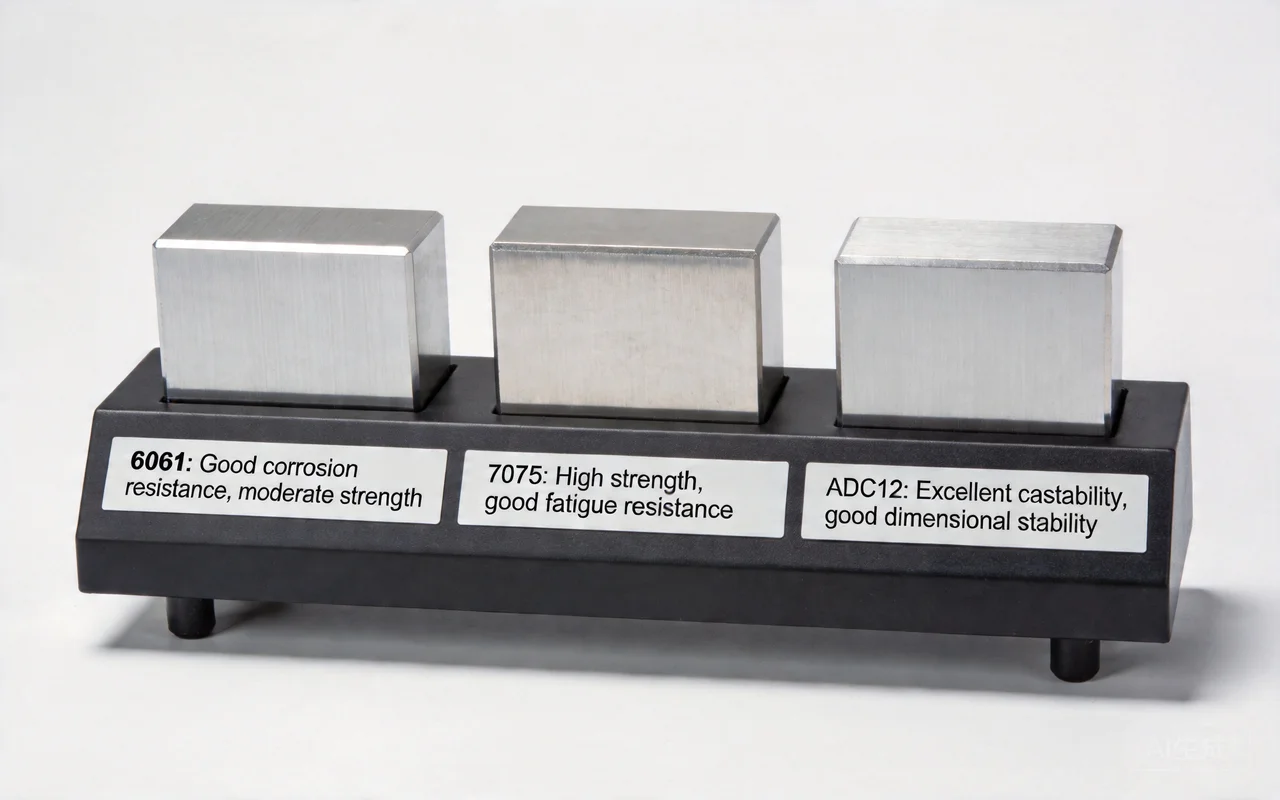
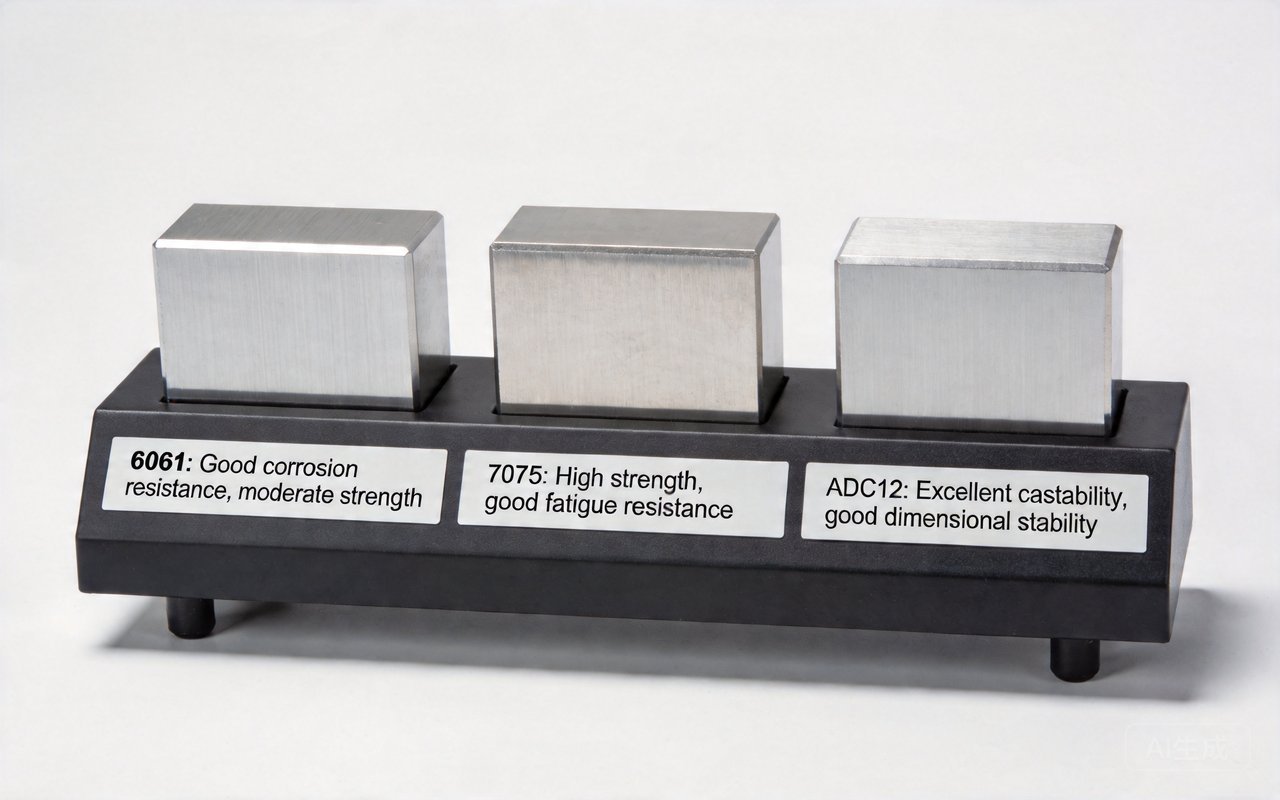
Composition: Al 95.8–98.6%, Mg 0.8–1.2%, Si 0.4–0.8%. Yield 276 MPa, tensile 310 MPa, elongation 12–17%, hardness ~95 HB. Excellent weldability and corrosion resistance; heat treatable to T6. Best for structural CNC parts, marine fittings, and general automotive components where machinability and cost balance matter.
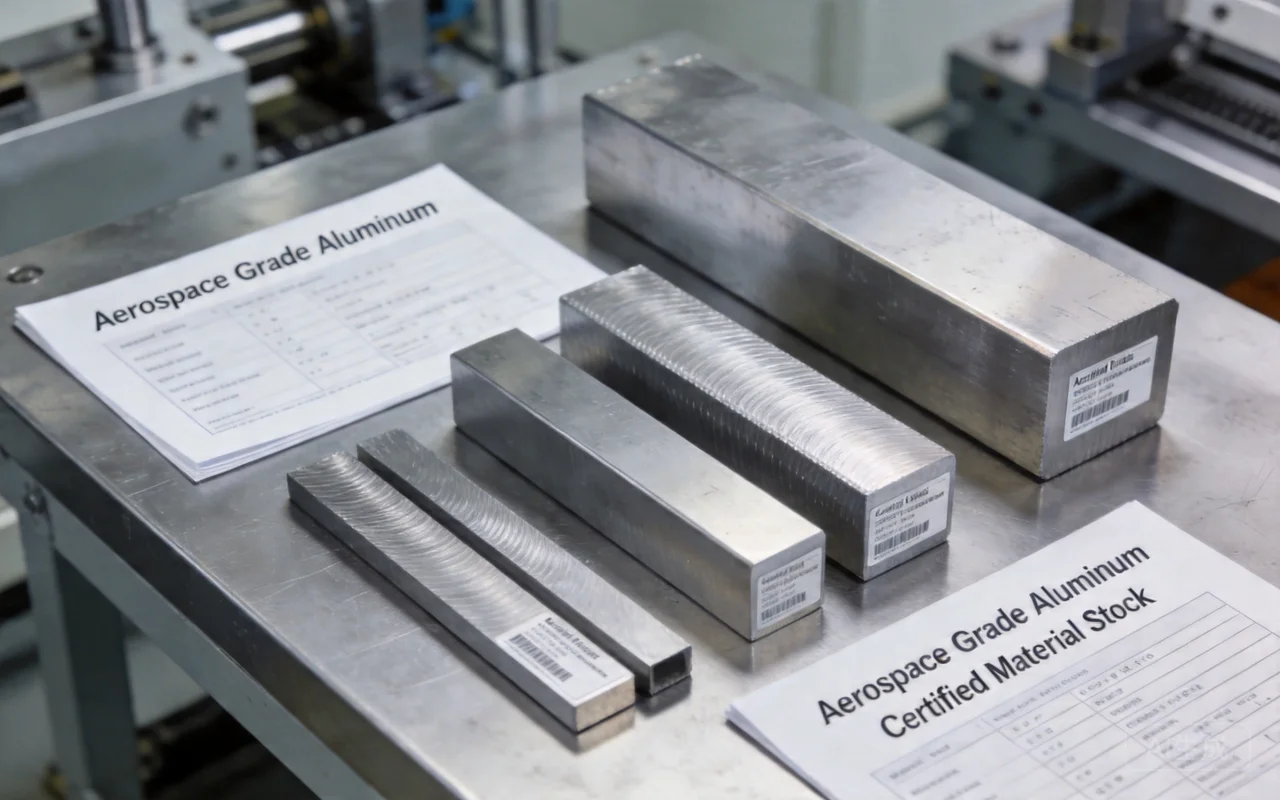
Composition: Al 87.1–91.4%, Zn 5.1–6.1%, Mg 2.1–2.9%, Cu 1.2–2.0%. Yield 503 MPa, tensile 572 MPa, elongation ~11%, hardness ~150 HB. Highest strength among common wrought aluminums; fair weldability; stress-corrosion risk in certain environments without coating. Used for aerospace structural parts and high-stress tooling machined from billet.
Composition: Al 76–81%, Si 9.6–12%, Cu 1.5–3.5%. Tensile ~310 MPa, elongation 2–3%, hardness 95–110 HB. Formulated for die casting with excellent fluidity; not effectively heat treatable for ductility gains. Ideal for automotive blocks, housings, and consumer electronics at high volume.
Casting alloy with tensile 262 MPa (T6), elongation 5–10%, hardness 80–90 HB. Excellent castability for gravity and sand casting of complex geometries. Lower cost than machining from 6061 billet for medium-complexity cast parts requiring heat treatment.
| Property | 6061 | 7075 |
|---|---|---|
| Strength | Medium | Very High |
| Machinability | Excellent | Good |
| Corrosion Resistance | Excellent | Moderate |
| Cost | Lower | Higher |
| Applications | General parts | Aerospace |
| Property | 6061 | ADC12 |
|---|---|---|
| Process | CNC Machining | Die Casting |
| Strength | Medium | Medium |
| Surface Finish | High | Good |
| Cost | Higher | Lower (volume) |
| Best Use | Precision parts | Mass production |
| Property | 7075 | ADC12 |
|---|---|---|
| Strength | Very High | Medium |
| Manufacturing | CNC | Casting |
| Cost | High | Low |
| Applications | Aerospace | Automotive |
| Property | 6061-T6 | 7075-T6 | ADC12 | A356-T6 |
|---|---|---|---|---|
| Yield Strength (MPa) | 276 | 503 | 160 | 207 |
| Ultimate Tensile (MPa) | 310 | 572 | 310 | 262 |
| Elongation (%) | 12–17 | 11 | 2–3 | 5–10 |
| Hardness (HB) | 95 | 150 | 95–110 | 80–90 |
| Machinability | Excellent (90%) | Good (70%) | Fair | Good |
| Corrosion Resistance | Excellent | Moderate | Good | Good |
| Weldability | Excellent | Fair | Poor | Good |
| Heat Treatable | Yes (T6) | Yes (T6) | No | Yes (T6) |
| Typical Cost | $$ | $$$$ | $ | $$ |
| Best Process | CNC / Casting | CNC | Die Casting | Gravity / Sand |

CNC machining: 6061-T6 is the most cost-effective default for general structural parts; specify 7075-T6 only when yield strength above 450 MPa is required and budget allows.
Die casting: ADC12 is the industry standard for high-volume thin-wall parts. 7075 is not castable in conventional HPDC — use ADC12 or A380 instead.
Gravity casting: A356-T6 is ideal for permanent mold parts needing heat treatment and moderate elongation. 6061 can be cast with careful parameter control but is not preferred.
Sand casting: A356, A319, and 535 alloys offer the best combination of fluidity, strength after T6, and tooling economy for prototypes and low-to-medium volumes.
ADC12 die cast, 5,000+ pcs/year. Chosen for lowest per-part cost and acceptable strength in a non-critical mounting bracket. Post-cast machining limited to critical bores only.
7075-T6 CNC from billet, ~200 pcs/year. Strength-critical interface; machining cost acceptable at low volume where die casting tooling cannot be justified.
6061-T6 machined and anodized, 500–1,000 pcs/year. Corrosion resistance priority; 7075 avoided due to SCC risk in saltwater without hard anodize.
ADC12 or 6061 depending on volume.
7075 for strength.
6061 for machining and finishing.
6061 for versatility.
Using 7075 when 6061 is sufficient increases cost.
Not all materials are suitable for casting or machining.
Low-cost materials may reduce performance.
No. 7075 is a wrought alloy optimized for machining from billet. For high-strength castings, use A356-T6, A319, or 535 alloys in sand or gravity processes.
ADC12 offers the lowest per-part cost in high-volume die casting. For CNC machining, 6061-T6 billet is typically the most economical structural alloy.
6061-T6 provides excellent marine-grade corrosion resistance. 7075 requires protective coating in aggressive environments due to copper content.
Specify 7075 only when yield strength above ~400 MPa is required. For most brackets, housings, and fixtures, 6061-T6 delivers adequate strength at 30–50% lower material cost with better machinability.
Contact us today for expert material recommendations and fast quotation tailored to your project.