How to Choose an Aluminum Casting Manufacturer: A 6-Step Buyer's Guide
Choosing an aluminum casting manufacturer is a sourcing decision that shapes part quality, cost, and delivery for the life of a program. This guide breaks the decision into six steps — process fit, certifications, quality control, capacity, geography, and the RFQ — so you can qualify a foundry with confidence. Start with our aluminum casting guide to confirm the right process, then use the checklist below.
Why Choosing the Right Casting Partner Matters
The aluminum casting supplier you select determines part quality, tooling cost, scrap rate, and on-time delivery for the entire life of a program. A mismatched partner — one whose core process, alloy experience, or quality system does not fit your part — can turn a routine bracket or housing into months of rework. This guide walks through the criteria buyers should weigh when qualifying a foundry, whether you are sourcing in the United States, Asia, or Europe.
Before you compare suppliers, define your part: target volume, alloy, tolerance class, surface finish, and any pressure-tightness or structural requirements. These drive the right process — see our aluminum casting guide for how sand, gravity, and die casting differ, and aluminum casting vs CNC machining for whether casting is the right route at all.
Step 1: Match the Process to Your Part
No single foundry process is best for every part. The most common mistake buyers make is forcing a part into a supplier's preferred process rather than choosing a supplier whose process fits the part. Use part volume, wall thickness, and tolerance to narrow the field before you shortlist vendors.
| Process | Best volume range | Typical tolerance | Tooling cost | Choose when |
|---|---|---|---|---|
| High-pressure die casting | 10,000–1,000,000+ /yr | ±0.10–0.25 mm on small features | Highest | Thin-wall, high-volume, tight tolerance parts. |
| Gravity (permanent mold) casting | ~1,000–50,000 /yr | Moderate | Medium | Medium volumes, thicker walls, better properties than sand. |
| Sand casting | 1–10,000 /yr | Loosest; ±0.5 mm+ | Lowest | Large parts, prototypes, low volumes. |
A capable partner should be able to recommend the most economical process for your volume — not just sell you the one they own. Foundries that offer multiple processes under one roof (die, gravity, and sand) give you flexibility as volumes change.
Step 2: Verify Quality Certifications and Standards
Certifications are the single fastest filter when qualifying a casting supplier. They prove a documented quality system exists and is audited by a third party. Ask for current certificates and confirm the scope covers casting (not just machining or trading).
- ISO 9001 — the baseline general quality management standard; expect every serious supplier to hold it.
- IATF 16949 — the automotive quality management standard built on ISO 9001; required for most OEM and Tier-1 automotive work.
- AS9100 — the aerospace quality management standard, layered on ISO 9001; needed for aerospace and defense castings. See our aerospace capabilities.
- ISO 14001 — environmental management; increasingly expected by Western buyers.
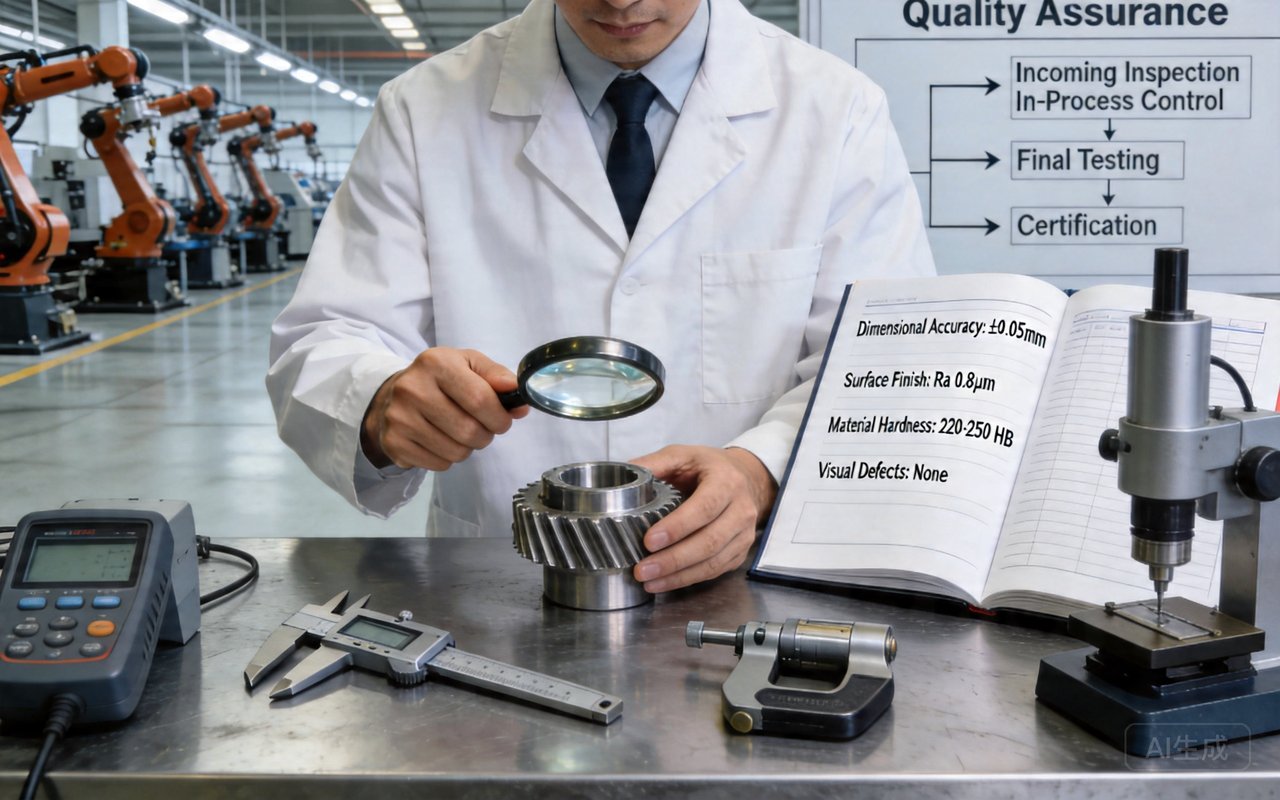
Certification alone is not proof of quality, but its absence is a strong warning sign. Pair the certificate check with a review of the supplier's quality control process — first-article inspection, in-process checks, and final dimensional reports.
Step 3: Evaluate Quality Control Capability
A casting partner's quality system is only as good as the equipment and discipline behind it. Ask how they detect porosity, dimensional drift, and surface defects before parts ship. Strong suppliers provide documented evidence rather than verbal assurances.
Look for: dimensional inspection using CMM (coordinate measuring machines), X-ray or CT for internal porosity on critical parts, spectrometer alloy verification on each heat, and documented first-article inspection (FAI) reports. Our casting defects guide explains the defects a robust QC program is designed to catch.
Step 4: Assess Capacity, Equipment, and Scalability
Capacity mismatches surface late and hurt the most. A supplier that is ideal for prototype quantities may struggle at production volume, and a high-volume die caster may not want a 500-piece order. Confirm the foundry's machine tonnage range, number of cells, and current utilization.
Review the equipment list and ask about secondary operations: do they offer in-house CNC machining, heat treatment, and surface finishing, or do they subcontract? In-house secondary operations shorten lead time and reduce the number of suppliers you must manage. See our equipment list for the kind of detail you should expect.
Step 5: Weigh Geography, Lead Time, and Total Cost
Domestic and overseas suppliers each carry trade-offs. A U.S. foundry offers shorter shipping, easier site visits, and simpler communication, but often higher piece price. An overseas partner can lower piece and tooling cost, at the expense of longer lead times, freight, and time-zone friction.
Evaluate total landed cost, not piece price alone: tooling, freight, duties, inventory carrying cost, and the cost of quality risk. For many programs the right answer is a hybrid — tooling and high-volume production offshore, with critical or fast-turn parts sourced regionally. Our cost reduction tips cover how design and sourcing choices move total cost.
Step 6: Run a Disciplined RFQ and Sample Build
The RFQ is where you separate capable partners from order-takers. A complete RFQ package — 2D drawings, 3D model, alloy spec, tolerance call-outs, finish requirements, and annual volume — lets suppliers quote accurately and reveals how technically engaged they are. Suppliers who respond with DFM (design for manufacturability) feedback are usually the ones worth keeping.
Always qualify with samples before committing to production. A first-article sample run validates tooling, dimensions, and surface finish against your drawing. Build the cost and schedule of sampling into your timeline rather than skipping it to save weeks — a failed production launch costs far more.
Step 7: Test Communication and Project Management
Technical capability means little if you cannot get clear answers when a program is under pressure. During the RFQ and sampling phase, treat every interaction as a preview of the production relationship. How quickly does the supplier respond? Do answers come from an engineer who understands casting, or from a sales contact relaying messages? Are quotes itemized so you can see where cost sits?
For overseas partners, language and time-zone gaps amplify these issues, so look for an English-speaking engineering contact and a defined escalation path. The best suppliers assign a single project owner who tracks tooling milestones, sample dates, and production releases. A partner who is responsive, transparent, and technically engaged before you place an order is far more likely to manage problems well once parts are flowing.
Step 8: Check Financial Stability and Order Fit
A casting program can run for years, so the supplier's stability matters. A foundry that is financially stretched may cut corners on maintenance, struggle to fund tooling, or disappear mid-program. Ask about years in business, customer references in your industry, and whether they serve customers of similar size and volume to you.
Order fit works both ways. Confirm the supplier's minimum order quantity (MOQ) and whether your volume is meaningful to them. A very small order at a high-volume die caster may receive low priority, while a high-volume program at a prototype shop may overwhelm capacity. Aligning your volume with the supplier's sweet spot is one of the strongest predictors of a smooth program. Our case studies show the kind of programs that fit our capabilities.
Step 9: Protect Tooling, IP, and Drawings
Casting often involves proprietary part designs and supplier-funded or customer-funded tooling, so clarify ownership and protection up front. Put a non-disclosure agreement (NDA) in place before sharing 3D models or drawings, and state clearly in the contract who owns the tooling and where it is stored.
Tooling ownership matters because it determines how easily you can move production if the relationship ends. A buyer who owns the tooling can transfer it to another foundry; a buyer who does not may be locked in. Spell out tooling location, maintenance responsibility, and transfer rights in the supply agreement rather than assuming them.
Common Red Flags to Avoid
Some warning signs reliably predict trouble. Be cautious of a supplier who quotes a complex part instantly without asking technical questions, refuses to share certifications or sample inspection reports, or has no documented quality process. A piece price far below every other quote usually signals a hidden cost — thinner walls, looser tolerances, or quality risk that surfaces later.
Other red flags include vague answers about defect rates and scrap, unwillingness to provide first-article inspection data, and no plan for secondary operations. None of these alone disqualifies a supplier, but several together mean you should keep looking. Trust evidence — certificates, inspection reports, and sample parts — over assurances.
The Casting Partner Decision Checklist
Use this checklist to score and compare shortlisted suppliers on a common basis. Weight the criteria according to your part: tolerance-critical aerospace work weighs certifications and inspection heavily, while a cost-driven commodity part weighs piece price and volume fit.
| Criterion | What to verify | Why it matters |
|---|---|---|
| Process fit | Offers the right process for your volume and tolerance. | Wrong process drives cost and scrap. |
| Certifications | ISO 9001 minimum; IATF 16949 / AS9100 as required. | Proof of an audited quality system. |
| Quality control | CMM, spectrometer, X-ray/CT, documented FAI. | Catches defects before parts ship. |
| Capacity | Tonnage range, utilization, in-house secondary ops. | Determines scalability and lead time. |
| Total landed cost | Tooling, piece price, freight, duties, quality risk. | Piece price alone is misleading. |
| Communication | Engineering contact, responsiveness, project owner. | Predicts how problems get handled. |
| Stability & fit | Years in business, references, MOQ, volume match. | De-risks a multi-year program. |
| IP & tooling | NDA, tooling ownership and transfer rights. | Protects designs and avoids lock-in. |
No supplier scores perfectly on every line. The goal is a clear-eyed comparison so you choose a partner whose strengths match what your part actually needs — and so you walk into the relationship knowing exactly where the risks sit.
From Qualification to a Stable Supply Relationship
Selecting the supplier is the beginning, not the end. The strongest casting relationships are built during the first production runs, when both sides learn how the part actually behaves and where the process needs tightening. Plan for a ramp period: agree on an initial production volume, hold a launch review after the first lots ship, and capture any tooling tweaks or process adjustments in writing before scaling up.
Set up the basics that keep a program healthy over years. Define the inspection level and reporting you expect on each shipment, agree on how engineering changes are handled and re-validated, and establish a single point of contact on each side. Schedule periodic business reviews to track quality trends, on-time delivery, and cost. A supplier who welcomes this structure is signaling that they intend to be a long-term partner rather than a one-time vendor.
Finally, keep a realistic view of risk. Even a well-chosen partner can be disrupted by demand spikes, raw-material swings, or logistics. For critical parts, know whether your tooling can be transferred and whether a qualified second source is worth establishing. The point of a disciplined selection process is not only to pick the right foundry today, but to enter the relationship with eyes open — clear on the part requirements, the supplier's strengths, and the contingencies that protect your program. With those in place, an aluminum casting partner becomes an extension of your own engineering and supply team.
Frequently Asked Questions
- What certifications should an aluminum casting manufacturer have?
- At minimum, look for ISO 9001 covering the casting operation itself. Automotive parts typically require IATF 16949, and aerospace parts require AS9100. ISO 14001 for environmental management is increasingly expected. Always confirm the certificate is current and that its scope includes casting, not only machining or trading.
- How do I compare a U.S. casting supplier with an overseas one?
- Compare total landed cost, not piece price alone: tooling, freight, duties, inventory carrying cost, and quality risk. U.S. suppliers offer shorter lead times, easier site visits, and simpler communication; overseas suppliers often lower piece and tooling cost. Many programs use a hybrid — offshore tooling and volume, regional sourcing for critical or fast-turn parts.
- Are there different grades of cast aluminum?
- Yes. Common die casting alloys include A380, A383, A413, and ADC12, while sand and gravity casting often use A356 or 356. Each grade balances castability, strength, ductility, and corrosion resistance differently, so the right alloy depends on the part's loads, finish, and pressure-tightness needs. A good supplier helps you select the grade.
- How much does it cost to cast aluminum?
- Cost has two parts: tooling and piece price. Die casting tooling can run from the low tens of thousands to hundreds of thousands USD depending on size and cavity count, while per-part cost falls sharply at volume. Sand casting has low tooling cost but higher piece cost. Request quotes against a complete RFQ to compare suppliers accurately.
- Should I order samples before full production?
- Yes — always qualify with a first-article sample run before committing to production. Sampling validates tooling, dimensions, alloy, and surface finish against your drawing and catches problems while they are cheap to fix. Build sampling time into your schedule; a failed production launch costs far more than a few weeks of qualification.